

Mortgage rates fell last week to their lowest level in more than three years after President Donald J. Trump said he had ordered his “representatives” to buy $200 billion in mortgage-backed securities, an unusual intervention aimed at reducing borrowing costs for homebuyers.
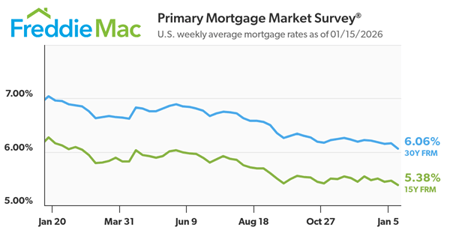 The average interest rate on a 30-year, fixed-rate mortgage was 6.06 percent for the week ending Jan. 15, 2026, down from 6.16 percent the prior week and 7.04 percent a year earlier, according to Freddie Mac’s weekly Primary Mortgage Market Survey.
The average 15-year, fixed-rate mortgage — often used by homeowners who refinance — fell to 5.38 percent, down from 5.46 percent the week before and 6.27 percent a year ago.
“Late last week, mortgage rates dropped, driving the weekly average down to its lowest level in more than three years,” Sam Khater, Freddie Mac’s chief economist, said, adding that purchase applications and refinancing had increased.
In Massachusetts, loan officers are quoting rates below 6 percent. One experienced loan officer told Buyers Brokers Only last week that strong borrowers, e.g., high credit scores, low debt-to-income ratios, and significant savings, might qualify for a 30-year, fixed-rate mortgage at 5.75 percent.
Mr. Trump did not name the entities he wanted to carry out the bond purchases, but suggested that Fannie Mae and Freddie Mac had ample reserves to do so. Subsequently, Federal Housing Finance Agency Director William Pulte confirmed on social media that Fannie Mae and Freddie Mac will conduct the mortgage bond purchases and that initial purchases had begun.
Should Home Buyers Purchase a Home When Interest Rates Decline?
Mortgage industry experts say that the effect on mortgage interest rates may be modest and could fade quickly. Broader forces, such as inflation rates, unemployment numbers, and the overall strength of the economy, drive interest rates.
For first-time buyers, the recent dip carries a familiar lesson: rates move fast, and trying to time them can backfire. A slight decline can draw more shoppers into the market, increasing bidding pressure and pushing prices higher, especially in supply-starved areas. A dip in interest rates today can reverse tomorrow.
Home-buying consumer advocates and lenders typically urge would-be home buyers to focus less on headlines and more on what they can afford each month, the stability of their income, and their cash cushion for repairs and closing costs. If the payment works and the home fits their needs, they say, waiting for the “perfect” rate can mean missing the right house — and the chance to build equity while rates keep shifting.