

For a limited time, eligible first-time homebuyers in Massachusetts may qualify for up to $25,000 in MassHousing down payment assistance at 0 percent interest.
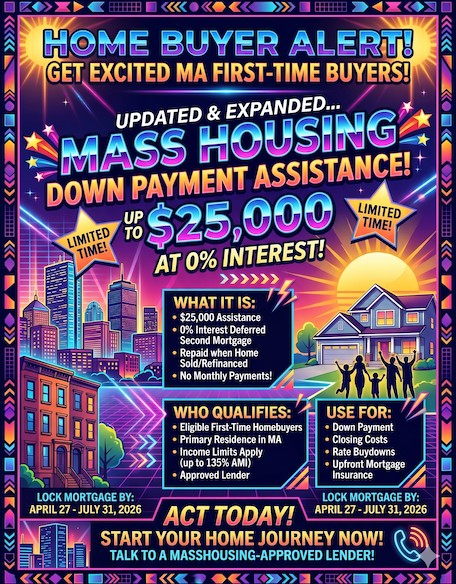 The program is available to buyers who lock a MassHousing mortgage between April 27 and July 31, 2026, and it can be used for a down payment, closing costs, prepaid mortgage insurance, and certain permanent rate buydowns. It is not a grant, though. It is a deferred second mortgage that is repaid when the home is sold, refinanced, or when the first mortgage is paid off.
MassHousing says the limited-time change expands access for more middle-income homebuyers across the state. Massachusetts Gov. Maura Healey’s administration said the new 0 percent structure is expected to help about 1,000 first-time homebuyers and could save buyers up to $31,000 over the life of the loan compared with the previous version of the program.
The program is welcome news for low- to moderate-income homebuyers in Greater Boston. With the median price of a single-family home in Greater Boston reaching $785,000 in March 2026, according to The Warren Group, any assistance helps prospective home buyers reach their home-buying goals.
What is the MassHousing down payment assistance program?
MassHousing’s updated and expanded statewide down payment assistance program offers eligible first-time buyers a fixed $25,000 loan at 0 percent interest for a limited window in 2026. The assistance must be paired with a MassHousing mortgage.
According to MassHousing, the funds can be used for a down payment, closing costs, permanent interest rate buydowns, and upfront mortgage insurance premiums.
This version temporarily replaces the older MassHousing assistance loan, which carried interest rates of 2 percent to 3 percent and was structured as a 15-year second mortgage. Under the new temporary terms, repayment is deferred, meaning no monthly payments are due on the assistance loan as long as the borrower owns the home and maintains the first mortgage. The balance becomes due upon sale, refinance, or payoff of the first mortgage.
Who is eligible for the new 0 percent MassHousing down payment assistance?
To qualify, buyers generally must meet the following criteria:
- Be a first-time homebuyer.
- Lock a MassHousing mortgage between April 27 and July 31, 2026.
- Have a household income at or below 135 percent of the area median income.
- Buy a single-family home, condo, or 2- to 4-family property in Massachusetts as a primary residence.
- Work through a MassHousing-approved lender.
MassHousing says the program is available in every city and town in Massachusetts. On its eligibility page, the agency states that borrowers earning less than $205,335 may qualify, though exact limits depend on the property location and other factors.
For example, the income cap in Worcester County is $165,645. MassHousing also has credit score requirements that vary by loan type, property type, and loan-to-value ratio. Minimum credit scores range from 640 to 700, according to the MassHousing website.
Pro Tip: Prospective first-time homebuyers should start by speaking with an experienced loan officer who is approved to assist borrowers with MassHousing loans. Homebuyers should be prepared to discuss their income and debt, and to provide documentation. You can’t just have a five-minute phone call and find out if you qualify. Don’t know an experienced MassHousing-approved loan officer? Get a referral today.
Is MassHousing’s down payment assistance program a grant or a loan?
The MassHousing down payment assistance program is a loan, not a grant. More specifically, it is a second mortgage with 0 percent interest and deferred repayment. The “deferred repayment” matters because homebuyers do not make ongoing payments on the assistance balance as they would with a standard amortizing loan, yet the money must still be repaid later under the program rules.
For many buyers, that structure may make the program more useful at the front end of the purchase process, when cash for the down payment and closing costs is often the biggest obstacle to homeownership.
Why does the MassHousing down payment assistance change matter in 2026?
Massachusetts, and particularly the Greater Boston area, remains one of the country’s more expensive housing markets. In March 2026, the median price of a single-family home stood at $785,000, according to The Warren Group, a publisher of real estate data. The updated MassHousing program aims to reduce one of the biggest barriers to buying a home: upfront cash.
State officials said the temporary 0 percent version is funded by using $25 million to reduce the interest cost on these assistance loans. For first-time homebuyers, the practical benefit is simple: lower upfront cash requirements, no interest on the assistance loan provided during the temporary program window, and no required payments on that second mortgage until a future triggering event, such as a sale or refinance.
Does MassHousing still offer up to $30,000 in down payment assistance?
Yes, MassHousing still offers up to $30,000 in down payment assistance for certain first-time homebuyers who meet specific income limits. On its website, the agency states that some eligible buyers may also qualify for mortgage insurance premiums paid by MassHousing. That means buyers should not assume the temporary $25,000 option is automatically the best fit for their situation without comparing available programs with a lender.
Since the beginning of 2023, MassHousing has delivered more than $1.9 billion in mortgage financing, helping over 5,900 households become homeowners. During that time, the agency has issued 4,757 down payment assistance loans. Over the past 18 months, nearly all first-time homebuyers using MassHousing have relied on down payment assistance to purchase a home, according to the state’s announcement of the program.
How can homebuyers get started?
Prospective homebuyers who think they may qualify for the down payment assistance program should speak with a MassHousing-approved lender as soon as possible. Because the temporary 0 percent offer depends on the date the MassHousing mortgage is locked, timing matters. Buyers should also confirm income limits, property type requirements, cash-to-close requirements, and whether the home they want to buy meets MassHousing guidelines.
A dedicated real estate buyer agent can guide you through the home-buying process and explain how the home search, financing timeline, offer strategy, negotiations, and closing costs fit together.
FAQ: MassHousing Down Payment Assistance
How much is the new MassHousing down payment assistance?
The MassHousing down payment assistance program is up to $25,000 at 0 percent interest for eligible first-time buyers during the limited 2026 program window.
When is the 0 percent program available?
The down payment program is available for homebuyers who lock a MassHousing mortgage between April 27 and July 31, 2026.
Can the money be used only for the down payment?
No, MassHousing states that the down payment assistance may also be used for closing costs, permanent rate buydowns, and upfront mortgage insurance premiums.
Do you have to pay the down payment assistance back?
Yes, it is a deferred second mortgage (not a grant) which is generally repaid when the home is sold, refinanced, or when the first mortgage is paid off.
Is the down payment program statewide?
Yes. MassHousing’s down payment assistance program is available in all cities and towns in Massachusetts.
Does MassHousing’s down payment assistance program have income limits?
Yes, prospective homebuyers should consult an experienced loan officer at a MassHousing-approved lender for details. Generally, borrowers in Greater Boston earning less than $205,335 may qualify, though exact limits depend on the property's location and other factors. For example, the income cap in Worcester County is $165,645.
Is the down payment assistance program only for first-time homebuyers?
Yes, the temporary 0 percent assistance is for eligible first-time homebuyers using a MassHousing mortgage.
Can I use the down payment assistance program to buy a condominium?
Yes, eligible homebuyers may purchase a single-family home, condo, or 2- to 4-family property in Massachusetts as a primary residence.